

Ajvide Burial Ground and Stone Age Hunter-Gatherers
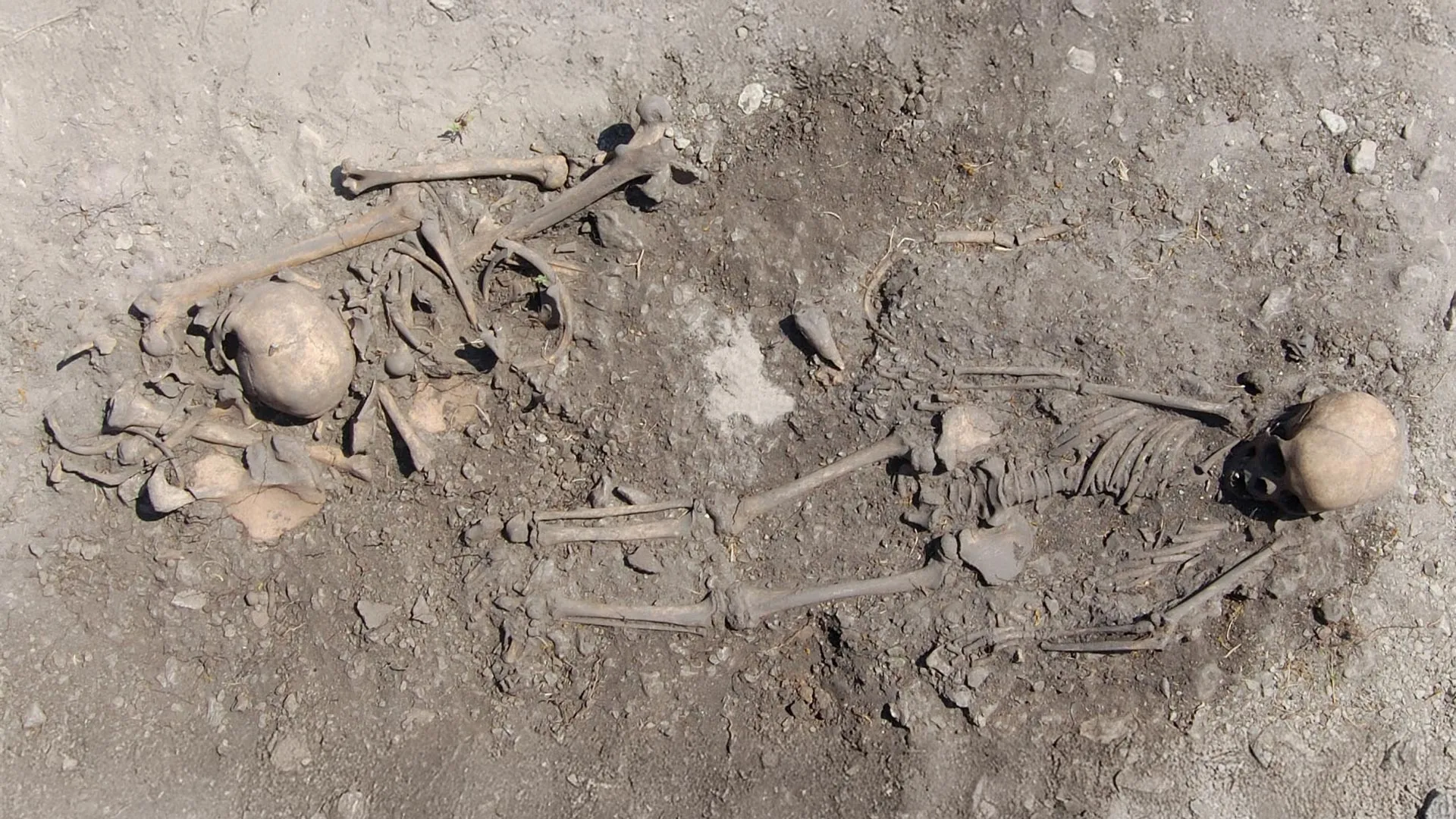
In a poignant Stone Age burial on Sweden’s Gotland island, a young woman was interred alongside two young children positioned close to her. For decades, archaeologists presumed these children were hers, but advanced DNA analysis has unveiled a far more nuanced reality. The genetic data confirms that the two children shared a close sibling bond, yet the woman bore no direct maternal link to them.
Nearby, in a separate grave, two other children were laid to rest together. Contrary to expectations of full siblings, their DNA profiles pointed to a more distant kinship, most plausibly as cousins.
These intriguing findings stem from cutting-edge research conducted by scientists at Uppsala University. The team meticulously examined four communal graves from a 5,500-year-old hunter-gatherer settlement at the Ajvide site on Gotland. The resulting genetic insights demonstrate that the inhabitants possessed a sophisticated awareness of their familial ties, with extended family members occupying significant positions within their social framework.
Ajvide Burial Ground and Stone Age Hunter-Gatherers
The Ajvide site stands as one of the premier Stone Age locations in Scandinavia, celebrated for its exceptionally preserved burials and rich array of artifacts. Approximately 5,500 years ago, communities of hunter-gatherers thrived in this area, relying primarily on hunting seals and fishing for sustenance. While agriculture had already taken root across large swaths of Europe during this period, the northern populations at Ajvide steadfastly adhered to their ancestral foraging traditions, maintaining a genetically distinct profile separate from the encroaching farmer groups in adjacent regions.
This expansive burial ground encompasses 85 documented graves, with eight featuring multiple occupants. The Uppsala researchers zeroed in on four of these multiple-interment sites, carefully extracting and sequencing DNA from the skeletal remains to map out the precise nature of the relationships between the buried individuals.
‘What surprised us most was how frequently those interred in the same grave turned out to be second- or third-degree kin, rather than the more commonly expected first-degree connections like parents with children or full brothers and sisters. This pattern underscores a deep understanding of genealogy among these people and highlights the vital contributions of broader family networks,’ explained archaeogeneticist Helena Malmström, who spearheaded the study’s methodological framework.
Burials With Children and Extended Relatives
Children featured prominently in the majority of the graves under scrutiny, offering a window into the communal burial practices of these ancient people.
One particularly evocative burial held the skeleton of a woman around 20 years old, positioned supine. Flanking her were the remains of a roughly four-year-old child on one side and a toddler of about one and a half years on the other. Genetic sequencing established that these children—a boy and a girl—were full siblings, sharing both parents. Strikingly, though, the adult woman was not their biological mother. The data strongly suggests she was their paternal aunt or potentially a half-sister through their father.
In another grave, a young girl was discovered buried with an adult male whose bones appeared to have been relocated from elsewhere. DNA evidence unequivocally identified the man as her biological father.
A third burial contained the remains of two children, once again a boy and a girl. Their genetic overlap indicated a third-degree relatedness, consistent with cousins sharing great-grandparents.
The fourth grave paired a girl with a young woman, whose DNA likewise revealed a third-degree connection, such as that between a great-aunt and niece or between cousins.
Insights Into Stone Age Social Organization
Intact burials from hunter-gatherer societies are exceptionally rare, making comprehensive investigations into their kinship structures few and far between.
‘Preservation of this caliber in hunter-gatherer contexts is so uncommon that kinship studies in these prehistoric groups remain limited in both number and scope,’ noted population geneticist Tiina Mattila, who led the DNA sequencing efforts.
‘These findings shed valuable light on the social dynamics of Stone Age societies,’ added Paul Wallin, Professor of Archaeology and a foremost authority on the Ajvide necropolis.
This research represents the pioneering application of archaeogenetics to probe familial bonds among Neolithic hunter-gatherers in Scandinavia. Building on this foundation, the team anticipates analyzing DNA from over 70 more individuals from the site. Their broader ambition is to illuminate the intricacies of social hierarchies, individual life trajectories, and ritualistic burial traditions in these long-vanished communities.
Facts: How sex and kinship were determined
To ascertain biological sex and degrees of relatedness, the scientists analyzed DNA extracted from the teeth and bones of the ten individuals involved. Skeletal morphology alone proves unreliable for sexing children, so the researchers turned to chromosomal analysis: two X chromosomes signify a female, while an X and a Y denote a male.
Kinship degrees were quantified by calculating the proportion of shared DNA segments. First-degree relations—parents and offspring or full siblings—exhibit about 50% identical DNA. Second-degree ties, such as grandparents with grandchildren or half-siblings, show roughly 25% sharing. Third-degree connections, including first cousins or great-grandparent-great-grandchild pairs, typically share around 12.5%.